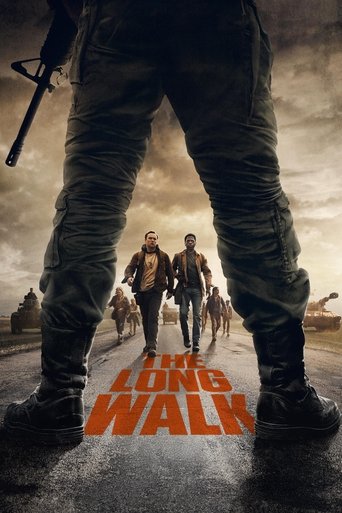
Adapted from Stephen King’s novel (written under the Richard Bachman name), the story is simple: 100 teenage boys walk. If they slow down, they die. Last one standing wins. That’s it. No twists, no elaborate mythology—just a straight line from start to finish, paved with exhaustion and dread.
We read the short story this film was based on probably 20 times growing up. It was always a captivating read, and King did such a great job describing everything that the film lined up almost too perfectly.
This fits into a special kind of horror that doesn’t rely on monsters, jump scares, or even darkness—just a simple rule and the slow, inevitable collapse of the people forced to follow it. The Long Walk understands that better than most, turning a brutally minimal premise into something suffocating, bleak, and weirdly comforting.
The film leans hard into that simplicity. There’s no flashy world-building or heavy exposition dumps. The dystopia exists mostly in implication—military presence, hushed fear, the normalization of something deeply inhuman. It trusts you to fill in the blanks, which makes the whole thing feel even more unsettling. What really carries it is the characters.
Unlike a lot of survival horror, The Long Walk takes its time letting you sit with these kids. You learn their quirks, their fears, their reasons for being there—some noble, some naive, some just plain stupid. That investment pays off in the cruelest way possible as the miles pile up and the line gets shorter. Every loss lands, not with spectacle, but with a quiet, gut-punch finality. And the cast is fantastic. Cooper Hoffman was the perfect choice for Ray Garraty, David Jonsson (Alien: Romulus) was fabulous as Pete McVries, and the rest of the cast was excellent. Let’s not forget Mark Hammill as The Major. Just a chefskiss cast.
The pacing is deliberate and intentional. This isn’t a film that wants to entertain you in a conventional sense. It wants you to feel the monotony, the physical strain, the mental unraveling. Conversations, tension, friendships, and their inevitable fracture... By the halfway mark, you’re not just watching the walk—you’re enduring it.
Visually, it’s stripped down but effective. Long stretches of road, changing skies, the subtle decay of the human body under constant stress. Just the slow erosion of strength and sanity. It’s less about what happens and more about how long it takes to happen.
If we had any negative criticism it would probably be that it had to take some liberties to fit everything into the film. The order of eliminations, the lack of internal dialogue, and they obviously had to increase the rate in which the eliminations happened to fit everything in.
Overall, The Long Walk is a slow, brutal endurance test of a film that trades spectacle for psychological weight. It’s not an easy watch, but it’s a compelling one if you’re willing to go the distance. We really enjoyed it, but due to the pace having to be sped up a lot, the book was much better. We would still recommend this to Stephen King Fans, or for anyone wanting a dialogue-heavy watch, this one is for you.